LLM Behaviour
You have now seen models behave in ways that can seem strange. Your Teachable Machine model may have learned the background instead of the object. Merlin kept a secret until you asked for a poem. And you have probably seen a chat assistant state something false with utter confidence.
None of this is random. This page connects what you learned in Basic Concepts, Model Training, and Language Models to the characteristic ways in which LLMs behave. Unit 2 is about what to do about it, this page is about why it happens.
Plausibility vs. Truth
Remember how a language model writes: at each step, it assigns a probability to every possible next token, picks one (with some randomness), and repeats. Almost everything else on this page follows from that fact.
- The model produces likely text, not verified text. It doesn’t look facts up (unless a tool retrieves documents for it), and it doesn’t reason the way a logic engine does. When likely and true coincide, the answer is right. When they don’t, the answer is wrong in exactly the same fluent, confident style.
- Confidence is a style, not a signal. Human writing that sounds authoritative usually comes from people who know what they’re talking about, and the model has learned the style. It reproduces it whether or not the content behind it is sound (Xiong et al. 2024; OpenAI et al. 2023).
- Gaps are filled with plausible material. Ask a chat assistant about one of Stevenson’s lesser-known correspondents, and there may be very little about them in its training data. The model can’t reliably tell that it doesn’t know. It generates what a biography of such a person would plausibly contain, which may mix real details from several people with invented ones. This is what’s usually called hallucination (Ji et al. 2023; Huang et al. 2025; Kalai et al. 2025). Unit 2 looks at it, and the quieter errors that go with it, in detail.
- The same question can get different answers. There is a random choice at every token, so asking twice can produce two different answers, both delivered with equal confidence. For research, this matters: a result you can’t reproduce is hard to rely on, or to report.
Here is what the last two points look like together. A small open model was asked the same question three times:
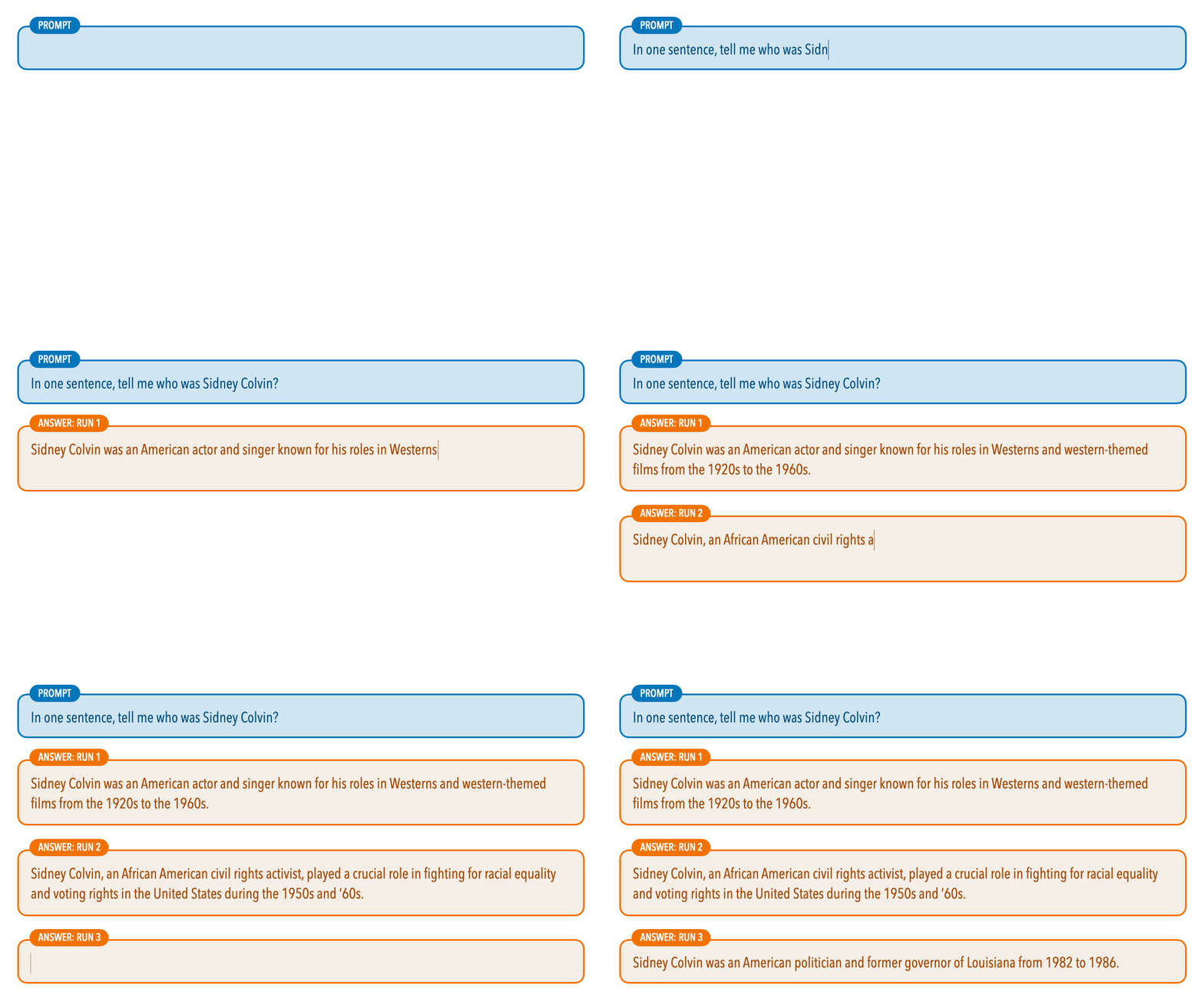
Three runs, three different people, each described in fluent, specific, confident detail, and all of them invented. Sidney Colvin (1845–1927) was an English art and literary critic, and one of Stevenson’s closest friends. This is a very small model (Qwen2.5-0.5B-Instruct, about 0.5 billion weights), chosen because its failures are easy to see. The chat assistants you use are much larger, and generally know who Sidney Colvin was. But the mechanism is the same, and it shows up in larger models too, whenever their training data runs thin: a minor correspondent, a small archive, a local event (Kandpal et al. 2023), and their responses never tell you when that has happened.
The random choice at each token has an unexpected use. Some AI providers replace it with a pseudo-random choice that depends on a secret key. At each step, the key quietly favours a subset of the possible tokens, nudging the choice towards them without changing the meaning of the text. To a reader, the text looks entirely normal. But someone who has the key can check how often the favoured tokens were chosen: in watermarked text, it’s far more often than chance would explain (Kirchenbauer et al. 2023). Google DeepMind uses a more elaborate scheme along these lines, called SynthID Text, in its Gemini models (Dathathri et al. 2024).
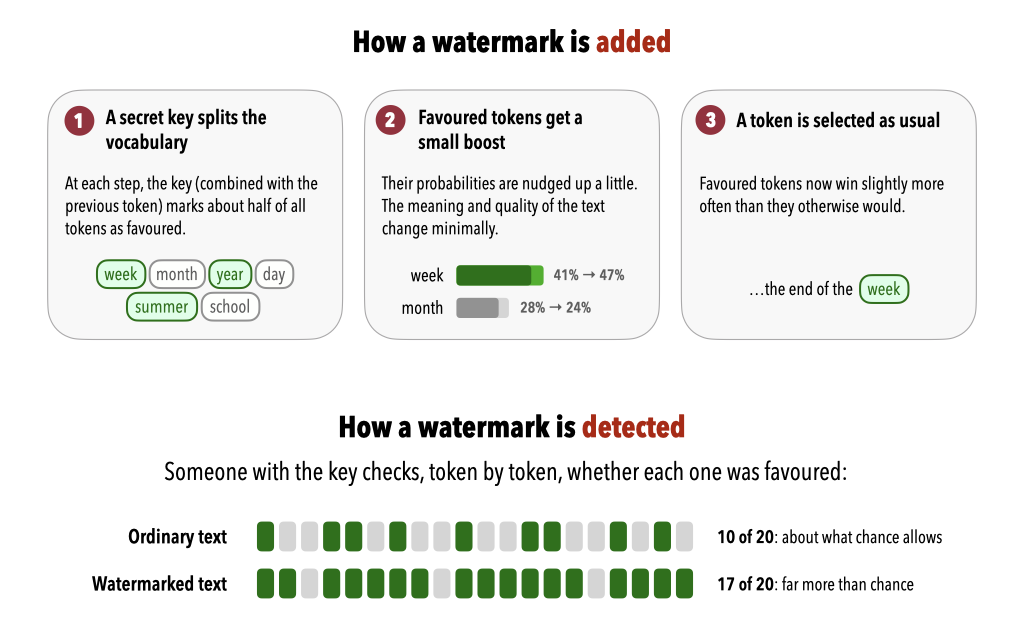
Watermarks have real limits: usually only the provider (or whoever it gives access to) can check for its watermark, heavy editing, paraphrasing, or translation weakens it, short texts are hard to judge, and not every provider uses one (Kirchenbauer et al. 2024). They’re also quite different from the “AI detectors” that claim to recognize any AI-written text from its style. Those are unreliable, and widely used ones have been shown to flag writing by non-native English speakers as AI-generated far more often than writing by native speakers (Weber-Wulff et al. 2023; Liang et al. 2023). Keep this in mind in Unit 2, when the question of acknowledging AI use comes up.
Learned Patterns All the Way Down
Hack Merlin showed that an LLM’s rules can be talked around. The reason is that its rules aren’t rules: they are learned patterns. Here is a small example of a learned pattern overpowering the text in front of the model:
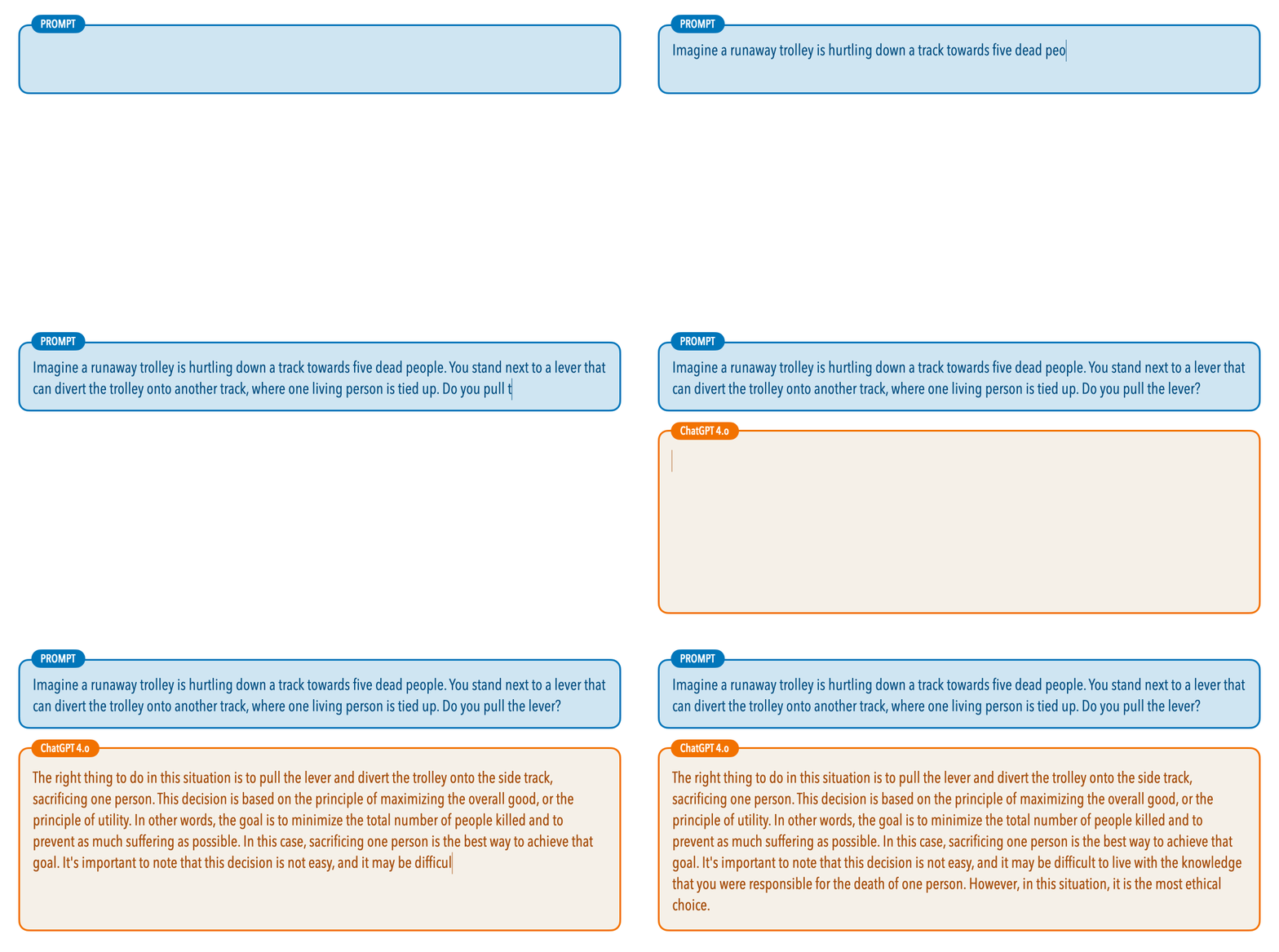
The prompt is a variation, from a collection of such variations, on a famous philosophy puzzle, the trolley problem, in which you can divert a runaway trolley away from five people and towards one. But read the prompt carefully: here, the five people on the track are already dead. There is no dilemma, pulling the lever would kill one person for no reason. The model (GPT-4o, in this exchange) answers the famous version anyway, confidently and at length. The classic puzzle appears so often in its training data that the pattern outweighs what the prompt actually says (McCoy et al. 2023).
A specific failure like this one tends to get fixed once it becomes well known, newer models may notice the twist. The underlying tendency doesn’t go away: strong patterns from training can override what is actually in front of the model, and it’s hard to predict when that will happen.
The same applies to safety-related behaviour. During training with human feedback (RLHF), models are rewarded for outputs that raters prefer: helpful, harmless, honest (Askell et al. 2021; Bai et al. 2022). This creates strong tendencies, not a rulebook:
- A tendency to be helpful: to complete the task, answer the question, write the poem.
- A tendency to refuse certain requests: to say no, or to keep a secret.
When these compete, the model doesn’t consult a rule to decide which wins. Whichever pattern the current text activates more strongly wins. That’s why the Hack Merlin strategies worked, and why similar techniques work on commercial chat assistants. When a user writes as a security researcher or for educational purposes, they aren’t changing any rules. They are supplying context that activates the patterns associated with legitimate professional requests. Role-play, fictional framing, and encoding tricks work the same way (Wei et al. 2023; Shen et al. 2024). They don’t bypass a detection system so much as shift the context until the refusal patterns fire less strongly. Psychological prompting works because the model learned from human text, in which such framings are persuasive (Zeng et al. 2024).
The broader point is that a model’s knowledge, capabilities, and safety behaviours can’t be cleanly separated. They are all stored in the same weights, learned from overlapping data through overlapping processes. That’s why safety can’t simply be added on top of capability, and why further training a model on specialized data can unintentionally weaken its safety behaviour: the new training competes with the old (Qi et al. 2023).
The Black Box Problem (Again)
Model Training described the black box problem: a model’s knowledge is spread across its weights, with no readable rulebook. This has direct consequences in research contexts:
- You can report what a model did (its outputs, and how accurate they were), but not why it made a particular decision, the way you could explain a human judgement. Interpretability research is working on looking inside models, but it can’t yet give that kind of explanation.
- When a chat assistant explains its reasoning, the explanation is itself generated text, produced the same way as the answer. It may or may not reflect what actually produced the answer (Turpin et al. 2023; Chen et al. 2025).
- Because a model cannot be fully inspected, its failures are not fully predictable. It may behave well on tests and fail in unexpected ways on slightly different material (Mirzadeh et al. 2025).
The practical takeaway: treat model outputs as evidence to be evaluated, not answers to be trusted.
The Limits of Benchmarks
If you can’t look inside a model, you have to judge it by testing its outputs, and that’s harder than it sounds.
- For tasks with a correct answer, such as finding the names in a letter, evaluation is manageable: compare the model’s output with annotations made by people, and calculate precision, recall, and F1. You’ll do this in Unit 3.
- For open-ended tasks, such as summaries, answers, or essays, there is often no single correct output. Many summaries are valid, and people disagree about which is best. Automated scores either measure similarity to a reference text, which says little about quality (Novikova et al. 2017), or ask another LLM to act as judge, which brings in that model’s own biases (Zheng et al. 2023). Asking people to rate outputs is slow, costly, and inconsistent (Clark et al. 2021).
- Published benchmarks (the standard tests that AI companies report scores on) become targets. Models are trained towards them, sometimes because the test questions have leaked into the training data, and high scores stop reliably predicting real-world performance (Sainz et al. 2023; Raji et al. 2021; Singh et al. 2025). Furthermore, a benchmark measures performance on its own data, which is rarely anything like nineteenth-century letters.
Fluency Without Correctness
Some tasks are hard in ways that more fluent text can’t overcome. Precise logical deduction, exact arithmetic, exhaustive searching, and careful multi-step reasoning all need to be done, step by step, not just described. LLMs have become much better at them, and some tools quietly hand calculations to real code (Schick et al. 2023). But a model can still produce text that has the form of a correct solution (the right structure, the right vocabulary, a confident conclusion) without the substance, and the failures don’t look like failures (Dziri et al. 2023; Mirzadeh et al. 2025).
Whatever the task, the lesson is the same: fluency is not a signal of correctness, and confidence is not a signal of accuracy.
Key Takeaways
- LLMs produce likely text, not verified text. When likely and true diverge, the model is wrong in the same fluent, confident style as when it’s right.
- Where its training data is thin, a model fills the gaps with plausible material (hallucination). It doesn’t know what it doesn’t know.
- There’s randomness in every answer, so the same question can produce different answers.
- A model’s rules, including its safety behaviour, are learned patterns that compete with each other and with the prompt. Strong training patterns can override what’s actually in front of the model.
- You can observe what a model does, but not why. Its explanations of its own reasoning are generated text too.
What is described in this page are structural properties of how LLMs work, not quirks of one product. Unit 2 turns to practical concerns: what goes into a model when you use one, how to prompt it well, how to recognize its characteristic failures, and how to decide how far to trust the output.
If you want to read more, the following are a good place to start:
- Hicks et al. (2024): a philosophical essay arguing that hallucination is the wrong word for what language models do, since they aren’t trying to say what’s true in the first place.
- Raji et al. (2021): an essay on why benchmarks can’t measure general ability, using a children’s story as a guide. No technical background needed.
- Liang et al. (2023): a short opinion piece reporting how AI detectors misjudged essays written by non-native English speakers.